MedTech Concept · Ophthalmology · Safety-First IA
Aegis Clinician: A Cockpit Where Every Safety Claim Is a Working Control
A one-week ophthalmology concept, rebuilt end-to-end in 2026 into a live workstation where every safety claim — identity, laterality, sign gates — is a working control, not a mockup.
- Identity disappeared on scroll
- Abnormal results had no owner
- AI drafts could reach signing unreviewed
A working ophthalmic workstation — identity relay, sign-blocking gates, AI scribe, and a fully procedural 3D eye — running in your browser. Every workflow claim on this page is inspectable there. Implementation claims are labeled with their evidence source.
All patient data is fictitious · Best on desktop; responsive with browser and GPU fallbacks

- Domain
- MedTech · Ophthalmology · Clinical Safety
- Deliverables
- Live workstation demo · Design system: 26 tokens, 17 text styles · Case narrative
- Scope
- Systems design · Procedural 3D anatomy · Verification protocol
From sprint to system
Rebuilding a concept until it can defend itself
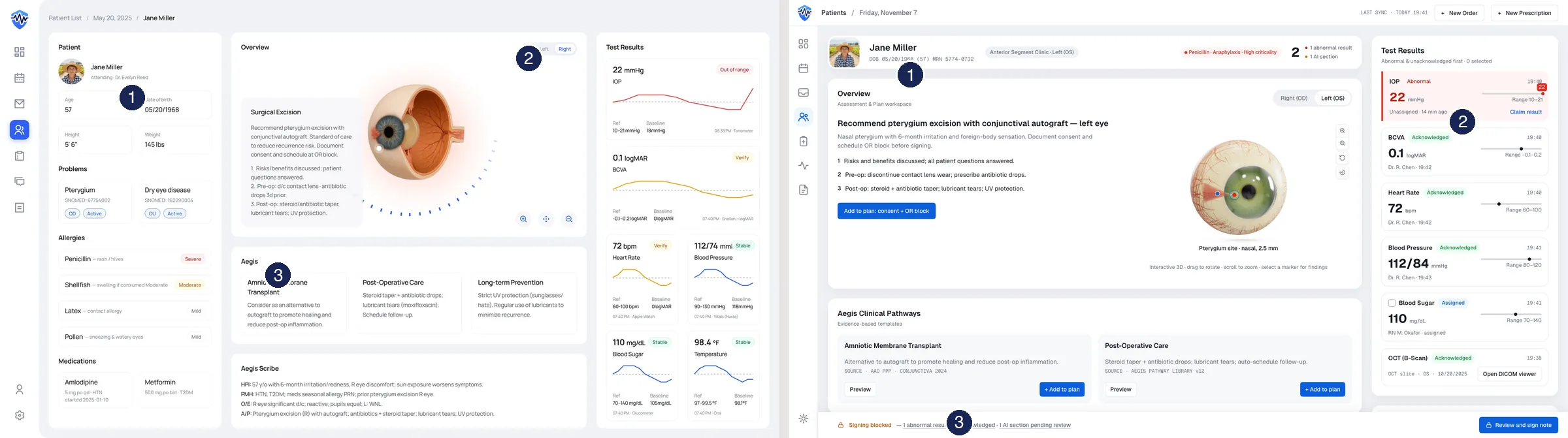
The original Aegis was a week of IA arguments — identity cockpit, results as a task queue, Draft→Review→Accept→Sign — validated only by an informal clinical review. A concept can claim anything; a working system has to survive its own claims. The 2026 rebuild kept the invariants and replaced every illustration with a control that enforces them.
Trade-off 1
Identity relay: the patient never leaves the screen
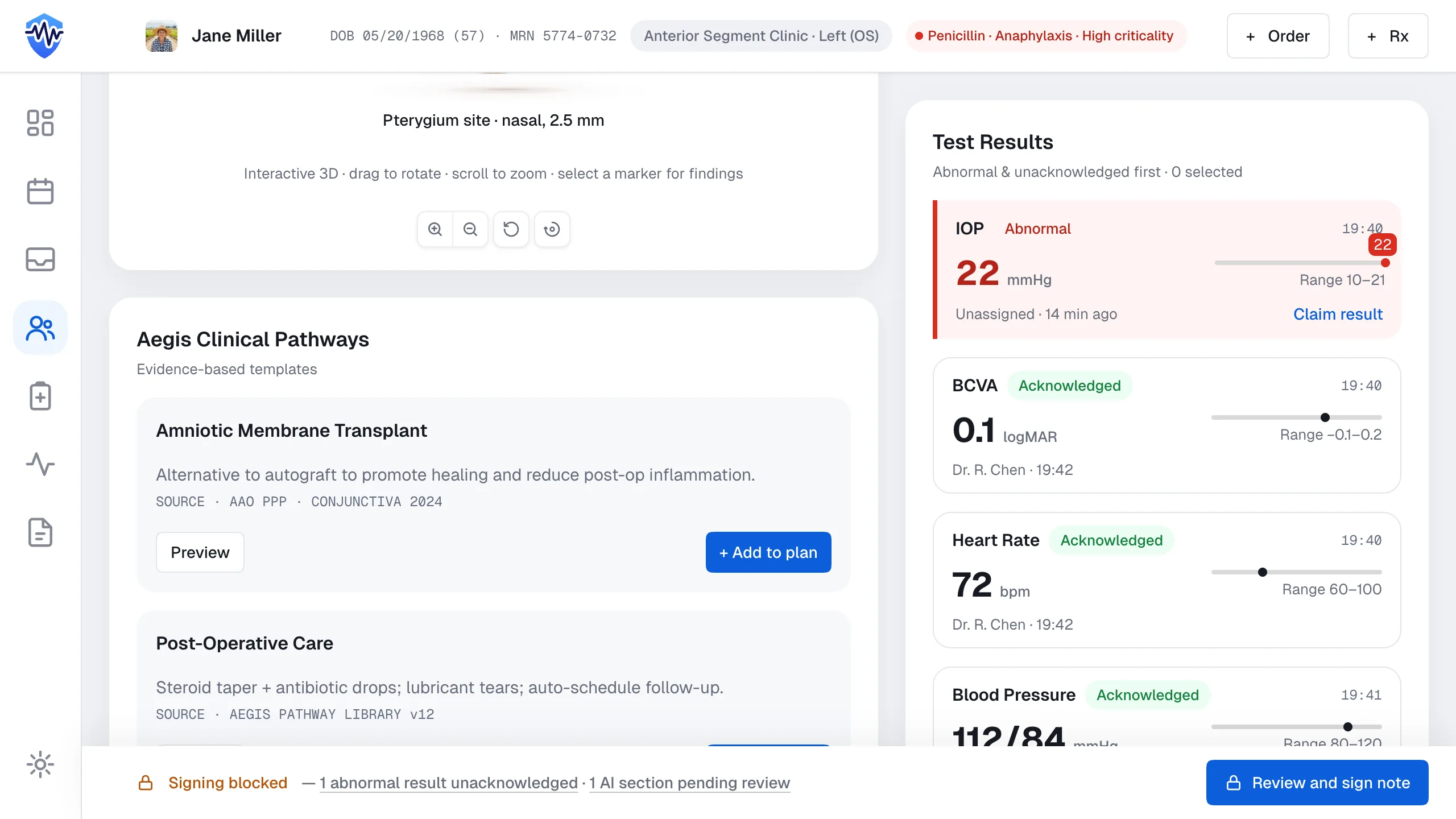
Name and allergy chain persist at every scroll position, handing off into the header with zero vacuum frames. I rejected a sticky banner: it taxes every screen to protect one failure mode. The relay costs nothing until the moment identity would vanish — which is the only moment that matters.
Trade-off 2
Laterality: OD on the left, and the deletion of “Both”
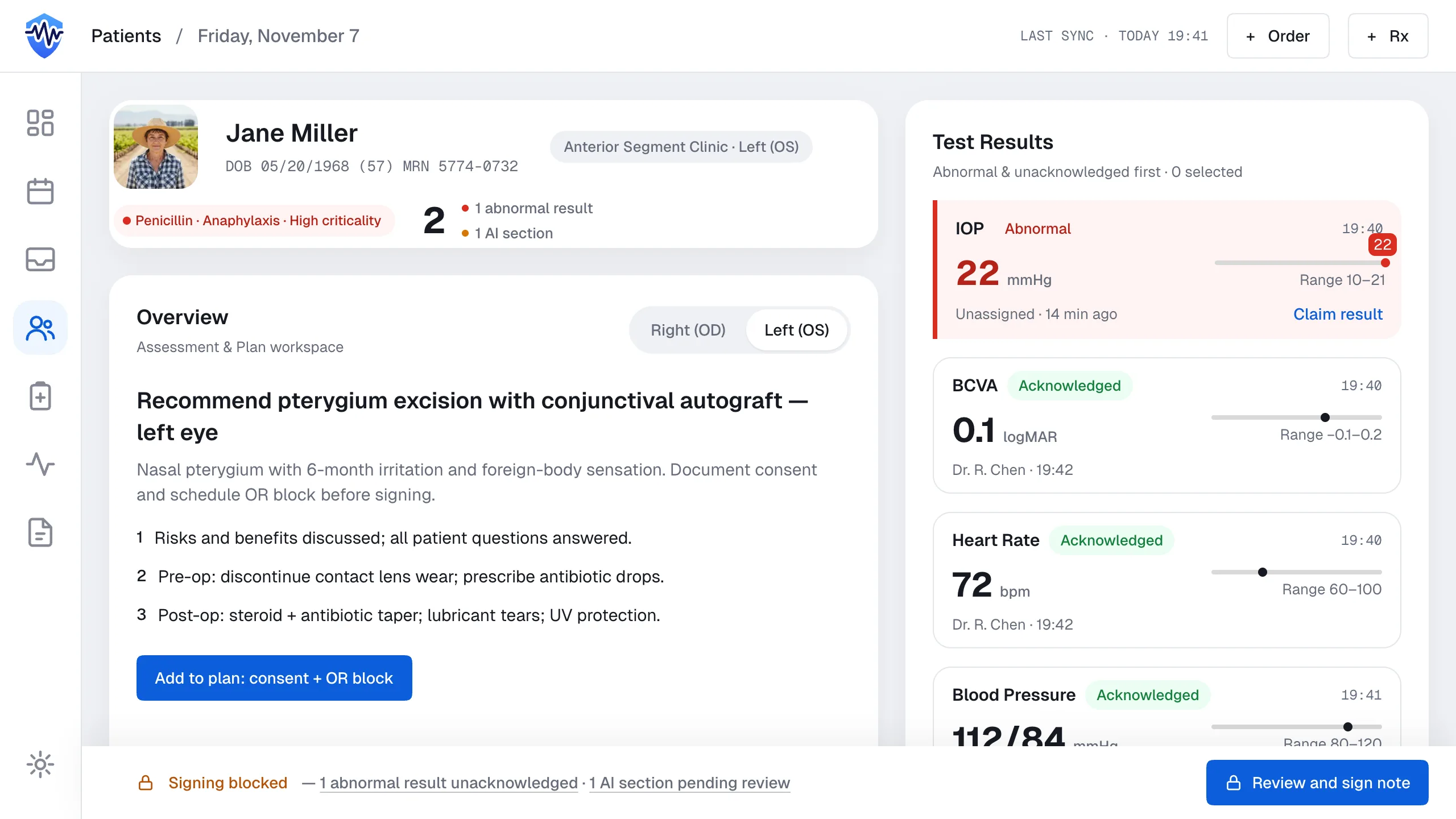
The layout follows the examiner’s view — OD displayed left — and a “Both” state was deleted; a later Compare tool was refused on the same grounds. Whatever merging saves in clicks, it spends in laterality ambiguity, and wrong-eye errors are not a cost I was willing to price in.

Trade-off 3
Closed-loop signing: unacknowledged results block the pen
Claim→Acknowledge gates feed a sign-blocking footer whose reasons deep-link to the exact unfinished item. I rejected warning-and-proceed: a warning is a liability transfer, not a safeguard. After signing, the record freezes and every frozen control explains itself; identity is re-verified at the pen.
Trade-off 4
Calm motion: attention is spent once
The motion system runs on four duration tiers and three curves under one charter: no idle loops in a chart. Hotspots announce themselves with a one-time halo and then hold still; auto-rotate defaults off. I rejected showroom motion because a chart is not a showroom — attention is spent once, then the record sits still.

The procedural eye
Anatomy owned in code
Why I rejected external models
A licensing investigation — an unlicensed viral repo, then a CC-BY model — ended with rebuilding the anatomy in pure code: anatomically zoned vessels with rectus insertion clusters and a perilimbal clear zone, a nasal feeder corridor into the pterygium wedge, hazel iris with collarette, glass cornea. Three hotspots each map to a charted finding with a record cross-reference; fake cross-section and layers tools were refused, because a surface model has no interior and the tool would render fiction with clinical confidence.


How I specified anatomy
Building it was its own experiment in directed AI work. I convened four specialist lenses — a color engineer, a graphic designer, a 3D modeling expert, and an ophthalmologist — and had them argue the eye into specification: exact sRGB ranges for a healthy sclera, vessel-coverage budgets with an anatomical map, corneal curvature in millimeters.
How the assertion loop failed and improved
Claude Code built to those numbers and then verified against them, screenshotting its own renders and asserting pixel ranges — sclera warmth, exactly one dominant highlight, wedge legibility at three camera angles — under a hard four-round cap. The loop caught what eyes miss and what pride hides: when a silent texture failure shipped a black eye behind a healthy-looking poster, the fix wasn’t a patch, it was doctrine — every build step now fails loudly or proves itself. When the render drifted from the style I wanted, I didn’t tune hex values; I set a new target and let the panel translate taste into assertions.
“Every build step now fails loudly or proves itself.”

Human-led, AI-amplified
The panel, the arbiter, the record
The rebuild ran as a directed system, not a prompt-and-hope loop.
Research partner
ChatGPT worked outside the build as research and review partner: reference audits, structured critique, the master rebuild prompt.
Builder & verifier
Claude Code worked inside it as builder and verifier — driving the Figma plugin API with pixel-parity assertion loops (137 text nodes within ±3px, measured in-file) and building the demo through role-based agent teams that included a standing medical-UI reviewer, plus a visual QA protocol where the procedural eye asserts pixel ranges on its own renders.
Arbitration owner
Recurring expert panels — ophthalmology, clinical IA, motion, accessibility, color engineering, 3D, performance, compatibility — argued in the open, and I arbitrated every conflict with recorded rationale. When the 3D and motion seats wanted the eye to auto-rotate on load, the medical seat objected, and I ruled for the chart: rotation defaults off, with a one-time attention halo instead. Direction, taste, arbitration, and the clinical honesty rules stayed with me. The tools amplified judgment; they never supplied it.
“The tools amplified judgment; they never supplied it.”
The system underneath
26 tokens, one blue, four tiers of motion
26 tokens and 17 text styles in shadcn-style conventions as the design→code bridge, hardened over six system frames and two hand-tuned passes. measured, in-file One-blue doctrine — action blue is reserved for the commit action and the focus ring; even pressed toggles use ink. WCAG 2.2 depth: roving tabindex, focus-not-obscured, screen-reader parity on the 3D stage, 320px reflow.


Outcomes
Verifiable outcomes
This is concept work: no deployment metrics exist, and none are claimed. Every number carries its evidence class; every workflow claim is inspectable in the live demo; implementation claims carry their evidence source.
- 339KB total transfer including the 3D scene. asserted, in-demo (DevTools Network)
- Zero external 3D assets; the anatomy is generated at runtime. asserted, in-demo (view source)
- Patient identity + allergy chain on screen at every scroll position, 8 viewports. designed invariant asserted, in-demo
- Signing blocked until every abnormal result is acknowledged; each reason deep-links. designed invariant (try to sign)
- 137 Figma text nodes within ±3px of the shipped demo. measured, in-file
- Dynamic aria on the identity handoff; keyboard rotation and screen-reader parity on the 3D stage; prefers-reduced-motion honored. asserted, in-demo
- WebGL context-loss recovery; three GPU tiers, self-benchmarked in 20 frames. asserted, in-demo
- Post-sign freeze: frozen controls explain themselves. asserted, in-demo
- Deployment, clinical outcomes, physician time saved. not claimed
Reflection
What the rebuild taught me
- My QA rotted from the outside. The first visual-QA protocol compared against external references that broke; verification that depends on outside artifacts decays. The rebuilt protocol is self-verifying — pixel assertions on the eye’s own renders — with a hard four-round cap, because unbounded self-checking burns budget without converging.
- The strongest safety moves were subtractions. I shipped “Both eyes,” then deleted it; nearly shipped Compare; refused cross-section. The clinical-honesty rules were discovered by deletion mid-build when they should have been charter on day one.
- An ophthalmologist agent is a lens, not a user. The laterality convention and hotspot rules are defensible reasoning, not validated practice. Production needs real clinician review, EHR integration, and a safety case — this demo proves craft, not clinical fitness.
Try the workstation
The original one-week concept is mine. The design system and live demo were rebuilt in 2026 in collaboration with Claude Code and reviewed with ChatGPT, on fictitious patient data throughout; direction, arbitration, and every final call are the author’s.